Chapter 12 : Integrating the Organization from End to End - Enterprise Resource Planning

Enterprise Resource Planning

  • Enterprise resource planning system are the organization's backbone in providing fundamental decision-making support
  • The heart of an ERP system is a central database that collects information from and feeds information into all the ERP systems's individual application components (called modules), supporting diverse business functions such as accounting, manufacturing, marketing and human resources

ERP process flow

Bringing the organization together

  • ERP enables employees across the organizations to share information across a single, centralized database
    • ERP - Bringing the Organization Together
      The organizaton before ERP

      The evolution of ERP


      • Originally, ERP solutions were developed to deliver automation across multiple units of an organization, to help facilitate the manufacturing process and adress issues such as raw materials, inventory, order entry, and distribution
      Integrating SCM, CRM, and ERP
      • Integration allows the unblocking of information to make it available to any user, anywhere and anytime
      Integration tools

      • Integration achieved using middleware - several different types of software that sit in the middle of and provide connectivity between two or more software applications
        • Enterprise application integration (EAI) middleware represents a new approach to middleware by packaging together commonly used functionality, such as providing prebuilt links to popular enterprise applications, which reduces the time necessary to develop solutions that integrate applications from multiple vendors
        Primary users and business benefits of strategic initiatives

        Integrations between SCM, CRM and ERP applications

        Chapter 11 : Building a Customer-centric Organization- Customer Relationship Management

        Customer Relationship Management

        • Customer relationship management (CRM) is a means of managing all aspects of a customer's relationship with an organization to increase customer loyalty and retention and an organization's profitability
        The Benefits of CRM
        • Enables a firm to treat customers as individuals, gaining important insights into their buying preferences and shopping behaviours 
        • Allows a firm to ensure that these customers receive the highest level of customer service and are offered the first opportunity to purchase new products
        • An organization must track 
          • How recently a customer purchased items
          • How frequently a customer purchases items
          • The monetary value of each customer purchase
        • Firm can analyze it to identify patterns and create marketing campaigns and sales promotions for different customer segments
        Evolution of CRM
        • CRM reporting technologies help organizations identify their customers across other applications
        • CRM analysis technologies help organizations segments their customers into categories such as best and worst customers
        • CRM predicting technologies help organizations predict customers behaviour 
        evolution of CRM
        Operational and Analytical CRM

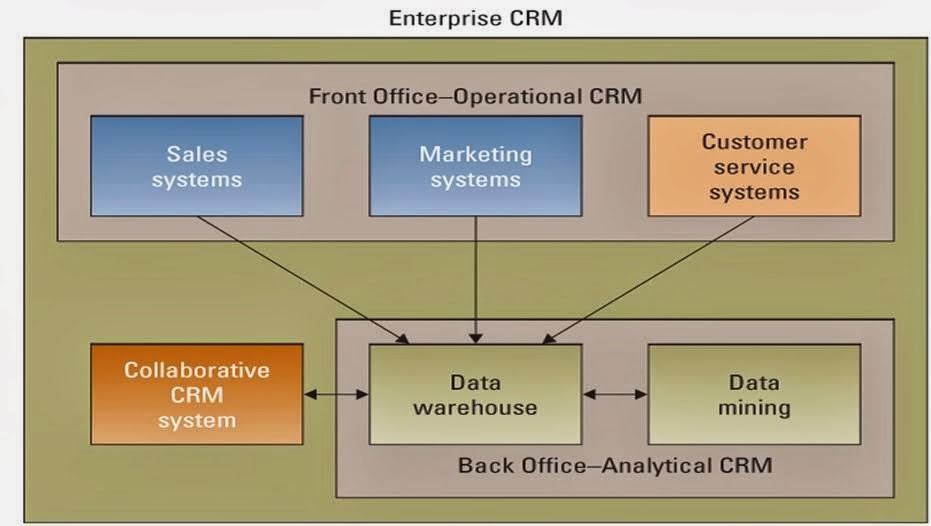
        • Operational CRM supports traditional transactional processing for day-to-day front office operations or systems to deal directly with the customers
        • Analytical CRM supports back-office operations and strategic analysis and includes all systems that do not deal directly with the customers
        Operational CRM and Analytical CRM 

        Chapter 10 : Extending the Organization - Supply Chain Management

        Basics of Supply Chain


        • Supply chain management (SCM) involves the management of information flows between and among stages in a supply chain to maximize total supply chain effectiveness and profatibility
        • The supple chains has three main links
          • Materials flow from suppliers and their upstream suppliers at all levels
          • Transformation of materials into semi-finished and finished products, or the organization's own production process
          • Distribution of products to customers and their downstreams customers at all levels
        The five basic supply chain management activities
        A typical supply chain
        Information Technology's Role in the Supply Chain
        • Information technology integrates planning, decision-making processes, business operating processes, and information sharing for business performance management

        The integrated supply chain
        Supply Chain Management Success Factors
        • Make the sale to suppliers
        • Wean employees off traditional business practises
        • Ensure the SCM system supports the organizational goals
        • Deploy in incremental phases and measure and communicate sucsess
        • Be future oriented