Chapter 19 : Outsourcing in the 21st Century

Outsourcing Projects

  • Insourcing is a common approach using the professional expertise within an organization to develop and maintain the organization's information technology systems
  • Outsourcing is an arrangement by which one organization provides a service or services for another organization that chooses not to perform them in-house
Outsourcing benefits
  • Increased quality and efficiency of a process, service, or function
  • Reduces operating expenses
  • Resources focused on core profit-generating competencies
  • Reduces exposure to risks involved with large capital investments
  • Access to outsourcing service provider's economies of scale
  • Access to outsourcing service provider's expertise and best-in-class-practise
  • Access to advanced technologies
  • Increased flexibility with the ability to respond quickly to changing market demand
  • costly outlay of capital funds
  • Reduced head count and associated overhead expense
  • Reduced frustration and expense related to hiring and retaining employees in an exceptionally tight job market
  • Reduced time to market to products or services
Outsourcing challenges
  • Contract length
  • Competitive edge 
  • Confidentiality
  • Scope definition

Chapter 15 : Creating Collaborative Partnerships

Web 2.0 : Advantages of Business 2.0

  • Web 2.0 is the next generation of internet use
Content sharing through open sourcing
  • Source code contains instructions written by a programmer specifying the actions to be performed by computer software
  • Open source refers to any software whose source code is made available free for any third party to review and modify
User-contributed content
  • Created and updated by many users for many users
  • One of the most popular forms of user-generated content is a reputation system, where buyers post feedback on sellers
Collaboration inside the organization 
  • A set of tools that supports the work of teams or groups by facilitating the sharing and flow of the information
  • Collective intelligence is collaborating and tapping into the core knowledge of all employees, partners, and customers
  • A knowledge management systems (KMS) supports the capturing, organization, and dissemination of knowledge throughout the organizations
Collaboration outside the organization
  • The most common form of collective intelligence found outside the organization is crowdsourcing, which refers to the wisdom of the crowd
Networking Communities with Business 2.0
  • Social media refers to websites that rely on user participation and user-contributed content, such as Facebook
  • Social networking is the practice of expanding your business and social contacts by constructing a personal networ
  • Social networking analysis (SNA) maps group contacts identifying who knows each other and who works together
  • Social tagging describes the collaborative activity of marking shared online content with keywords or tags as a way to organize it for future navigation, filtering, or search 
  • Website bookmark is a locally stored URL or the address of a file or internet page saved as a shortcut
  • Social bookmarking allows users to share, organize, search, and manage bookmarks
Business 2.0 Tools for Collaborating
  • Blogs
  • Wikis
  • Mashups
The Challenges of Business 2.0
  • Technology dependence
  • Information vandalism
  • Violations of copyright and plagarism

Chapter 14 : Ebusiness

Ebusiness Models

  • Business models is a plan that details how a company creates, delivers, and generates revenues
  • An ebusiness model is a plan that details how a company creates, delivers, and generates revenues on the internet
  • Ebusiness models fall into one of the four categories :
    • business-to-business (B2B)
      • applies to businesses buying from and selling to each other over the internet
    • business-to-consumer (B2C)
      • applies to any business that sells its products or services directly to the consumers online
    • consumer-to-business (C2B)
      • applies to any consumer who sells a product or services to a business on the internet
    • consumer-to-consumer (C2C)
      • applies to customers offering goods and services to each other on the internet
Ebusiness Tools for Connecting and Communicating
  • Email
  • Instant messaging
  • Podcasting
  • Video conferencing
  • Web conferencing
  • Content management systems
The Challenges of Ebusiness
  • Identifying limited market segments
  • Managing consumer trust
  • Ensuring consumer protection
  • Adhering to taxation rules

Chapter 12 : Integrating the Organization from End to End - Enterprise Resource Planning

Enterprise Resource Planning

  • Enterprise resource planning system are the organization's backbone in providing fundamental decision-making support
  • The heart of an ERP system is a central database that collects information from and feeds information into all the ERP systems's individual application components (called modules), supporting diverse business functions such as accounting, manufacturing, marketing and human resources

ERP process flow

Bringing the organization together

  • ERP enables employees across the organizations to share information across a single, centralized database
    • ERP - Bringing the Organization Together
      The organizaton before ERP

      The evolution of ERP


      • Originally, ERP solutions were developed to deliver automation across multiple units of an organization, to help facilitate the manufacturing process and adress issues such as raw materials, inventory, order entry, and distribution
      Integrating SCM, CRM, and ERP
      • Integration allows the unblocking of information to make it available to any user, anywhere and anytime
      Integration tools

      • Integration achieved using middleware - several different types of software that sit in the middle of and provide connectivity between two or more software applications
        • Enterprise application integration (EAI) middleware represents a new approach to middleware by packaging together commonly used functionality, such as providing prebuilt links to popular enterprise applications, which reduces the time necessary to develop solutions that integrate applications from multiple vendors
        Primary users and business benefits of strategic initiatives

        Integrations between SCM, CRM and ERP applications

        Chapter 11 : Building a Customer-centric Organization- Customer Relationship Management

        Customer Relationship Management

        • Customer relationship management (CRM) is a means of managing all aspects of a customer's relationship with an organization to increase customer loyalty and retention and an organization's profitability
        The Benefits of CRM
        • Enables a firm to treat customers as individuals, gaining important insights into their buying preferences and shopping behaviours 
        • Allows a firm to ensure that these customers receive the highest level of customer service and are offered the first opportunity to purchase new products
        • An organization must track 
          • How recently a customer purchased items
          • How frequently a customer purchases items
          • The monetary value of each customer purchase
        • Firm can analyze it to identify patterns and create marketing campaigns and sales promotions for different customer segments
        Evolution of CRM
        • CRM reporting technologies help organizations identify their customers across other applications
        • CRM analysis technologies help organizations segments their customers into categories such as best and worst customers
        • CRM predicting technologies help organizations predict customers behaviour 
        evolution of CRM
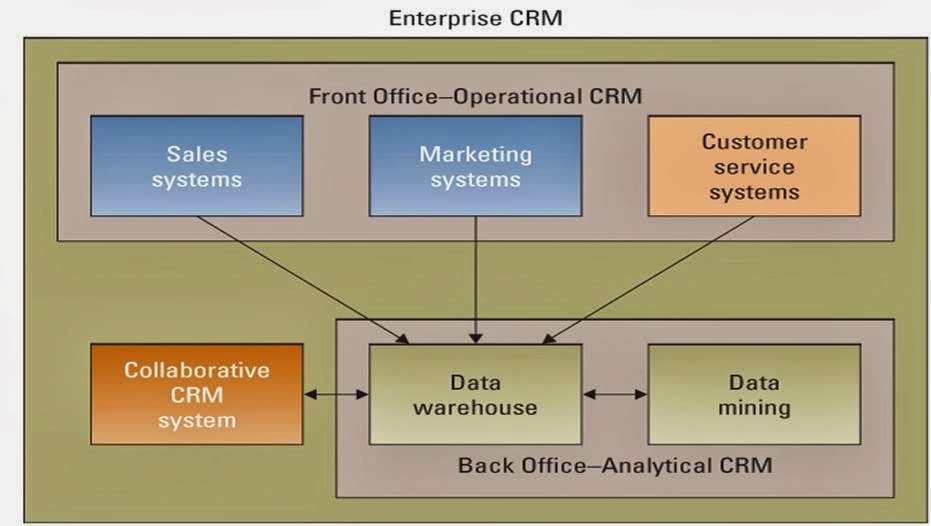
        Operational and Analytical CRM

        • Operational CRM supports traditional transactional processing for day-to-day front office operations or systems to deal directly with the customers
        • Analytical CRM supports back-office operations and strategic analysis and includes all systems that do not deal directly with the customers
        Operational CRM and Analytical CRM 

        Chapter 10 : Extending the Organization - Supply Chain Management

        Basics of Supply Chain


        • Supply chain management (SCM) involves the management of information flows between and among stages in a supply chain to maximize total supply chain effectiveness and profatibility
        • The supple chains has three main links
          • Materials flow from suppliers and their upstream suppliers at all levels
          • Transformation of materials into semi-finished and finished products, or the organization's own production process
          • Distribution of products to customers and their downstreams customers at all levels
        The five basic supply chain management activities
        A typical supply chain
        Information Technology's Role in the Supply Chain
        • Information technology integrates planning, decision-making processes, business operating processes, and information sharing for business performance management

        The integrated supply chain
        Supply Chain Management Success Factors
        • Make the sale to suppliers
        • Wean employees off traditional business practises
        • Ensure the SCM system supports the organizational goals
        • Deploy in incremental phases and measure and communicate sucsess
        • Be future oriented

        Chapter 9 : Enabling the Organization - Decision Making

        Making Business Decisions

        • Decision making process - plays a crucial role in communication and leadership for operational, managerial, and strategic projects
        • Decision making essentials (managerial decision making challenges)
          • Managers need to analyze large amounts of information
            • Innovation in communication and globalization have resulted in a dramatic increase in the variables and dimensions people need to consider when making a decision, problem solving or appraising an opportunity
          • Managers must take decisions quickly
            • Time is of the essence and people simply don not have time to sift through all the information manually
          • Manager must apply sophisticated analysis technique, such as Porter's strategies or forecasting, to make strategic decisions
            • Due to the intensely competitive global business environment, companies must offer far more than just a great product to succeed
        • Operational (decision making process)
          • Problem identification - Define the problem as clearly and precisely as possible
          • Data collection - Gather problem-related data, including who, what, where, when,why, and how. Be sure to gather facts, not rumours or opinions about the problem
          • Solution generation - Detail every solution possible, including ideas that seem fart etched
          • Solution test - Evaluate solutions in terms of feasibility (can it be completed?), suitability (is it permanent or a temporary fix?), and acceptability (can all participants from a consensus?)
          • Solution selection - Select the solution that best solution that best solves the problem and meets the needs of the business
          • Solution implementation - If the solution solves the problems, then the decisions made were correct. If not, then the decisions were incorrect and the process begins again
        • Managerial
          • At this level, employees are continuously evaluating company operations to hone the firm's abilities to identify, adapt to, and leverage change
          • These types of decisions are considered semi-structured decisions they occur in situations in which few established processes help to evaluate potential solutions, but not enough to lead to a definite recommended decisions
        • Strategic
          • At this level, managers develop overall business strategies, goals, and objectives as part of the company's strategic plan
          • Strategic decisions are highly unstructured decisions, occurring in situations in which no procedures or rules exist to guide decision makers toward the correct choice
        Enhancing Decision Making with MIS
        • Operational support systems
          • Transactional information encompasses all the information contained within a single business process or unit of work, and its primary purpose is to support the performance of daily operational or structured decisions
          • Online transaction processing (OLTP) is the capture of transaction and event information using technology to 
            • process the information according to defined business rules
            • store the information
            • update existing information to reflect the new information
        • Managerial support systems
          • Analytical information encompasses all organizational information, and its primary purpose is to support the performance of managerial analysis or semi-structured decisions
          • Online analytical processing (OLAP) is the manipulation of information to create business intelligence in support of strategic decision making
          • Decision support systems (DSSs) model information using OLAP which provides assistance in evaluating and choosing among different courses of action
        • Strategic support systems
          • Executive information system (EIS) is a specialized DSS that supports senior-level executives and unstructured, long term, non routine decisions requiring judgement, evaluation, and insight
        Interaction between TPS and DSS to Support Semi-structured Decisions
        The Future : Artificial Intelligence
        • Artificial intelligence (AI) simulates human thinking and behaviour, such as the ability to reason and learn
        • Intelligence systems are various commercial applications of artificial intelligence
        • Expert systems are computerized advisory programs that imitate the reasoning processes of experts in solving difficult problems
        • Neural networks (artificial neural network) is a category of AI that attempts to emulate the way the human brain works
          • Learning and adjusting to new circumstances on their own
          • Lending themselves to massive parallel processing
          • Functioning without complete or well-structured information
          • Coping with huge volumes of information with many dependent variables
          • Analyzing non linear relationships in information (they have been called fancy regression analysis systems)
          • Fuzzy logic is a mathematical method of handling imprecise or subjective information
        • Genetic algorithms is an artificial intelligence system that mimics the evolutionary, survival-of-the-fittest process to generate increasingly better solutions to a problem
        • Intelligent agents is a special-purpose knowledge-based information system that accomplishes specific tasks on behalf of its users
        • Virtual reality is a computer-stimulated environment that can be a simulation of the real world or an imaginary world

        Chapter 8 : Accessing Organizational Information - Data Warehouse

        History of Data Warehouse

        • The data warehouse provided the ability to support decision making without disrupting the day-to-day operations, because:
          • Operational information is mainly current – does not include the history for better decision making
          • Issue of quality information
          • Without information history, it is difficult to tell how and why things change over time

        Data Warehouse Fundamentals
        • Data warehouse – a logical collection of information – gathered from many different operational databases – that supports business analysis activities and decision-making tasks
        • The primary purpose of a data warehouse is to combined information throughout an organization into a single repository for decision-making purposes – data warehouse support only analytical processing
        • Data warehouse models
        • Multidimensional Analysis and Data Mining - relational Database contain information in a series of two-dimensional tables


        • In a data warehouse and data mart, information is multidimensional, it contains layers of columns and rows
          • Dimension – a particular attribute of information

          • Cube – common term for the representation of multidimensional information
          • Once a cube of information is created, users can begin to slice and dice the cube to drill down into the information
          • Users can analyse information in a number of different ways and with number of different dimensions

        Multidimensional Analysis and Data Mining
        • Data mining – the process of analysing data to extract information not offered by the raw data alone. Also known as "knowledge discovery" – computer-assisted tools and techniques for sifting through and analysing vast data stores in order to find trends, patterns, and correlations that can guide decision making and increase understanding
        • To perform data mining users need data-mining tools
        • Data-mining tool – uses a variety of techniques to find patterns and relationships in large volumes of information. Examples: retailers can use knowledge of these patterns to improve the placement of items in the layout of a mail-order catalogue page or Web page
        Information Cleansing or Scrubbing
        • An organization must maintain high-quality data in the data warehouse
        • Information cleansing or scrubbing – a process that weeds out and fixes or discards inconsistent, incorrect, or incomplete information
        • Occur during ETL process and second on the information once if is in the data warehouse
        • Contact information in an operational system


        • Standardizing Customer name from Operational Systems
        • Information cleansing activities

        • Accurate and complete information
        Business Intelligence
        • Business intelligence – refers to applications and technologies that are used to gather, provide access, analyze data, and information to support decision making effort
        • these systems will illustrate business intelligence in the areas of customer profiling, customer support, market research, market segmentation, product profitability, statistical analysis, and inventory and distribution analysis to name a few
        • Eg: Excel, Access 

        Chapter 7 : Storing Organizational Information - Database

        Relational Database Fundamentals

        • Database – maintains information about various types of objects (inventory), events (transactions), people (employees), and places (warehouses)
        • Database models include:
          • Hierarchical database model – information is organized into a tree-like structure (using parent/child relationships) in such a way that it cannot have too many relationships
          • Network database model – a flexible way of representing objects and their relationships
          • Relational database model – stores information in the form of logically related two-dimensional tables
        • Entity – a person, place, thing, transaction, or event about which information is stored
          • The rows in each table contain the entities
          • In Figure 7.1 CUSTOMER includes Dave’s Sub Shop and Pizza Palace entities
        • Attributes (fields & columns) - characteristics or properties of an entity class
          • The columns in each table contain the attributes
          • In Figure 7.1 attributes for CUSTOMER include Customer ID, Customer Name, Contact Name
        • Primary keys and foreign keys identify the various entity classes (tables) in the database
        • Foreign key – a primary key of one table that appears an attribute in another table and acts to provide a logical relationship among the two tables
        • Primary key – a field (or group of fields) that uniquely identifies a given entity in a table
        • Potential Relational Database for Coca-Cola Bottling Company of Egypt
        Relational Database Advantages
        • Increased flexibility
        • Increased scalability and performance
        • Reduced information redundancy
        • Increased information integrity (quality)
        • Increased information security

        Database Management Systems (DBMS)

        • Database management systems (DBMS) – software through which users and application programs interact with a database 

        • Data-driven Web sites – an interactive Web site kept constantly updated and relevant to the needs of its customers through the use of a database

        • Data Driven Web Site Advantages
          • Development
          • Content Management
          • Future Expandability
          • Minimizing Human Error
          • Cutting Production and Update Costs
          • More Efficient
          • Improved Stability

        • Data-Driven Business Intelligence

        Integrating Information among Multiple Devices
        • Integration – allows separate systems to communicate directly with each other
          • Forward integration – takes information entered into a given system and sends it automatically to all downstream systems and processes
          • Backward integration – takes information entered into a given system and sends it automatically to all upstream systems and processes

        • Building a central repository specifically for integrated information

        Group Assignment

        Answers :
        This error occurred when :

        Fraud in IT
         Another company tries to create a new product/services by stealing the main concept of Facebook operation. Due to the advances in technology, it is easier for people to copy everything.
        There’s an ethical and privacy issues here. Those people who stole this idea should consider the principles and standards that guide their behavior towards other people. They don’t have any rights and should be sued.

        If we decided to gain information from Facebook :
        •   Plagiarism and copyright issues may be occurred
        • The privacy of social networks cannot be fully trusted
        • False information may be added by other people
        • Internet violence
        • There are a lot of unscrupulous businesses that have sprung up on the internet to take advantage of people
        • Hackers can create viruses that can get into your personal computer and ruin valuable data
        How can Facebook do to prevent these types of error?

        The organization need to supervise the security systems more often. And the Chief Security Officer should be responsible to make sure the systems develop run smoothly and keep the privacy of the user safely. Private information should be store in proper way. To gain trust from the users, they should keep their copyright and once they’ve been fraud they can tighten their security and filter the information uploads by each of the user(s).

        • Nur Arina binti Azrein
        • Nur Hazirah binti Fadzil
        • Syaza Syahirah binti Mohd Rodzi
        • Muhammad Hakimi bin Hisham
        • Muhammad Shadan bin Umor

        Chapter 6 : Valuing Organizational Information

        Organizational Information

        • When addressing a significant business issue, employees must be able to obtain and analyse all the relevant  information so they can make the best decision possible
        • Information granularity refers to the extent of detail within the information
        • Successfully collecting, compiling, sorting, and finally analysing information from multiple levels, in varied formats, exhibiting different granularity can provide tremendous insight into how an organization is performing
        The Value Transactional and Analytical Information
        • Transactional Information encompasses all of the information contain within a single business process or unit of work, and its primary purpose is to support the performing of daily operational tasks
        • Analytical Information encompasses all organizational information, and its primary purpose is to support the performing of managerial tasks
        The Value of Timely Information
        • Real-time information means immediate, up-to-date information
        • Real-time systems provide real-time information in response to query requests
        The Value of Quality Information
        • Accuracy - Are all the values correct? For example, is the name spelled correctly? Is the amount recorded properly?
        • Completeness - Are any of the values missing? For example, is the address complete including street, city, state and zip code
        • Consistency - Is aggregate or summary information in agreement with detailed information? For example, do all total fields equal the true total of the individual fields?
        • Uniqueness - Is each transaction, entity, and event represented only once in the information? For example, are there any duplicate customers?
        • Timeliness - Is the information current with respect to the business requirements? For example, is information updated weekly, daily or hourly?
        - Understanding the costs of poor information - wrong information can lead to making the wrong decision that can cost time, money, and even reputations
          • Inability to accurately track customers, which directly affects strategic initiatives such as CRM and SCM
          • Difficulty identifying the organization's most valuable customers
          • Inability to identify selling opportunities and wasted revenue from marketing to non-existing customers and non-deliverable mail
          • Difficulty tracking revenue because of inaccurate invoices
          • Inability to build strong relationship with customers

        Chapter 5 : Organizational Structures That Support Strategic Initiatives

        IT Roles and Responsibilities

        • Chief information officer (CIO) - responsible for overseeing all uses of information technology and ensuring the strategic alignment of IT with business goals and objectives
          • Manager - ensure the delivery of all IT projects on time and within the budget
          • Leader - ensure the strategic vision of IT is in line with the strategic vision of the organization
          • Communicator - advocate and communication that IT strategy by building and maintaining strong executive relationships
        • Chief technology officer (CTO) - ensuring the throughout,speed, accuracy, availability,and reliability of an organization's information technology
        • Chief security officer (CSO) - ensuring the securities of IT systems and developing strategies and IT safeguards against attacks from hackers and viruses
        • Chief privacy officer (CPO) - ensuring the ethical and legal use of information within an organization
        • Chief knowledge officer (CKO) - responsible to collect, maintain and distribute the organization's knowledge
        The Gap between Business Personnel and IT Personnel
        • Business personnel - posses expertise in functional areas such as marketing, accounting, sales, and so forth
        • IT personnel - the technological expertise
        Organizational Fundamentals - Ethics and Security
        1. Ethics - the principles and standards that guide our behaviour toward other people
        2. Privacy - right to be left alone when you want to be, to have control over your own personal possessions, and not to be observed without your consent
        • Issues affected by technology advances
        • Although natural disasters may appear to be the most devastating causes of IT outages, they are hardly the most frequent or biggest threats uptime
        • Sources of unplanned downtime

        Chapter 4 : Measuring the Success of Strategic Initiatives

        1. Measuring Information Technology's Success - key performance indicators (KPIs) are the measures that are tied to business drivers. Metrics are the detailed measures that feed those KPIs. Performance metrics fall into a nebulous area of business intelligence that is neither technology-nor business-centred, this area requires input from both IT and business professionals to find success
        • Effectiveness IT metrics - measure the impact IT has on business processes and activities including customer satisfaction, conversion rates, and sell-through increases
        • Efficiency IT metrics - measure the performance of the IT system itself including throughput, speed, and availability
        • Benchmarking - a process continuously measuring systems results, comparing those results to optimal system performance, and identifying steps and procedures to improve systems performance
             2. The Interrelationship of Efficiency and Effectiveness IT Metrics
        • Common types of efficiency IT metrics
        • Common types of effectiveness IT metrics
             
             3. Metrics for Strategic Initiatives
        • Website metrics
        • Supply Chain Management (SCM) Metrics
        • Customer Relationship Management (CRM) Metrics
        • Business Process Re engineering (BPR) and Enterprise Resource Planning (ERP) Metrics
          • Balanced scorecard  is a management system, in addition to a measurement system, that enables organizations to clarify their vision and strategy and translate them into action
          • The balanced scorecard views the organizations from four perspectives :
            • The learning and growth perspective
            • The internal business process perspective
            • The customer perspective
            • The financial perspective

        Chapter 3 : Strategic Initiatives for Implementing Competitive Advantages


        •  Organizations can undertake high-profile strategic initiatives including
          • Supply Chain Management (SCM)
          • Customer Relationship Management (CRM)
          • Business Process Reengineering (BPR)
          • Enterprise Resource Planning (ERP)

        1. Supply Chain Management - involves the management of information flows between and among stages in a supply chain to maximize total supply chain effectiveness and profitability

        • Four basic components of supply chain management include :
          • Supply chain strategy - strategy for managing all the resources required to meet customer demand for all products and services
          • Supply chain partners - the partners chosen to deliver finished products, raw materials, and services including pricing, delivery, and payment processes along with partner relationship monitoring metrics
          • Supply chain operation - the schedule for production activities including testing, packaging, and preparation for delivery. Measurements for this component include productivity and quality
          • Supply chain logistics - the product delivery processes and elements including orders, warehouses, carriers, defective product returns, and invoicing
        • Effective and efficient supply chain management systems can enable the organization to : 
          • Decrease the buyer power
          • Increase supplier power
          • Increase switching costs
          • Create entry barriers
          • Increase efficiencies while seeking a competitive advantage through cost leadership
        Effective and efficient supply chain managements effect on Porter's Five Forces
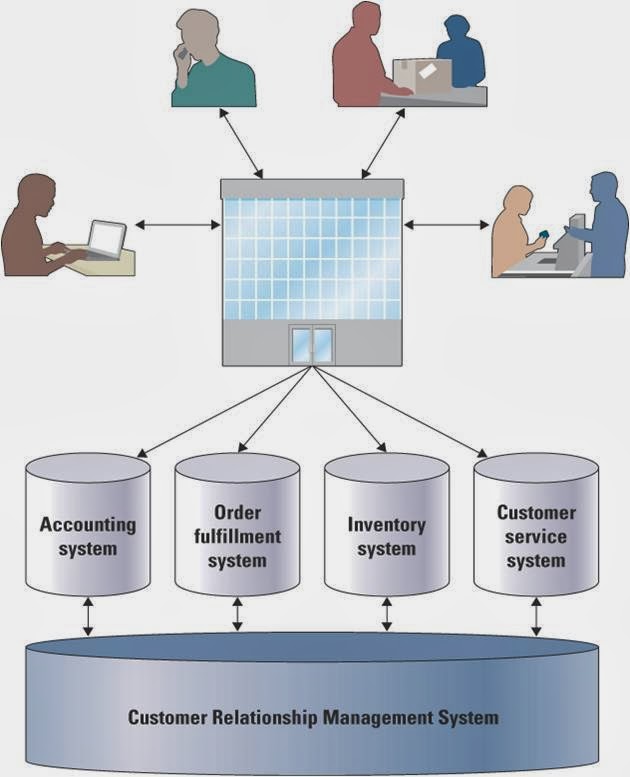
           2. Customer Relationship Management - involves managing all aspects of a customer's relationship with an organization to increase customer loyalty and retention and an organization's profitability

        • CRM is not just technology, but a strategy, process, and business goal that an organization must embrace on an enterprisewide level
        • CRM can enable the organization to
          • identify types of customers
          • design individual customer marketing campaigns
          • treat each customer as an individual
          • understand customer buying behaviours
        CRM overviews
            3. Business Process Reenginering - analysis and redesign of workflow within and between the enterprise

        • The purpose of BPR is to make all business processes best-in-class
        • Finding opportunity using BPR
        • Types of change an organization can achieve, along with the magnitudes of change and the potential business benefit


           4. Enterprise Resource Planning - integrates all departments and functions throughout an organization into a single IT system so that employees can make decisions by viewing enterprisewide information on all business operations
        • ERP systems collect data from across an organization and correlates the data generating an enterprisewide view